Thursday, April 16, 2020

Week Thirteen Prompt Response


The idea that libraries shouldn’t promote or carry titles because they’re not “legitimate” is so funny to me. There was obviously a time where deciding what’s best for readers was a part of the library ethos, but those days are long gone. Our purpose now is to provide a variety of options for patrons to choose from- especially options that patrons enjoy. Restricting that variety (especially in areas that in my experience have been very popular) would go against our purpose. Keeping our library’s true values in mind (as well as the idea that “legitimate” can become a slippery slope) is the first step to ensuring our ability to adequately serve patrons.

I think the most important thing we can do is continually note the virtues of YA and graphic novels so that we can be informed advocates. Both formats are incredibly popular and cover a wide variety of genres, character types, settings, etc., so they check both the “provide variety” and “provide what patrons like” columns. They’re also lower-pressure reads (not unlike a lot of genre fiction) and can be more accessible to readers with different processing styles (especially graphic novels). YA titles (and oftentimes graphic novels as well) also tend to be more diverse than adult fiction, especially when it comes to LGBT+ representation. In “Urban Grit,” Honig noted that genres that are seen as less valuable are often those that are targeted toward underrepresented or vulnerable groups, specifically mentioning “comic books” being aimed at teenagers (xvii). Both YA and graphic novels are often targeted towards teens, but their higher representation level overall could also apply here (another reason to advocate for their continued use). YA and graphic novels can also provide alternative avenues/perspectives on traditional genres like romance or fantasy to their adult/imageless counterparts. What might be most important, though, is how popular (and oftentimes even prestigious) YA (Harry Potter, John Green books, Simon Vs. the Homo Sapiens Agenda, The Hunger Games, Children of Blood and Bone, etc.) and graphic novels (Watchmen/V for Vendetta, Sandman, Maus, Persepolis, Saga, Fun Home, Akira, etc.) have been. YA is growing even more popular as their past readers “age out” of it but still wants to stick with the genre, and Marvel didn’t make billions of dollars in movie adaptations for graphic novels to be ignored.

We can also make specific efforts to include these genres in daily work. This would not only justify their usefulness, but also help “legitimize” them by placing them alongside other aspects of the collection. Inclusion could start with keeping an open communication line with children’s/teen librarians to maintain an up-to-date understanding of YA. Similarly, we can read up on both YA and graphic novels to know the best classic, popular, and emerging titles to request and recommend to patrons. From there, we can include YA and graphic novel titles in both our displays and regular recommendations. My library has a number of YA duplicates that are also inter-filed with adult fiction because they’re so popular, which could also be a possible pathway for those afraid to get past the “YA” label. By including these genres in daily tasks, both adult readers who already like them and those who may not have considered them an option before will have greater representation and exposure. Maybe they will even create new readers and further justify our collection- Flanagan noted in “What Girls Want” that “I hate YA novels; they bore me” yet spent the entire article raving about Twilight. Even adult readers who normally dismiss these genres might just need the right title.

Once we are fully including YA and graphic novels, we should keep records of circulation statistics, title requests/holds, and interaction with display materials to prove their popularity. Award lists can probably help advocate titles’ quality, but proof that patrons interact with and enjoy these materials will be a good way to prove their popularity as well. The only major threat to being able to continue serving adult patrons who like these genres are those within the library system, and while I doubt anyone in the library would actually want to remove either of these genres, records of works’ quality and popularity should convince them.

Flanagan, C. (2008). What girls want: A series of vampire novels illuminates the complexities of female adolescent desire. The Atlantic, 108-120.
Honig, Megan. (2011). Introduction. In Urban Grit: A guide to street lit. Santa Barbara: Libraries Unlimited.

Friday, April 10, 2020

Week Twelve Prompt Response


THE READER'S ADVISORY MATRIX for The Book of Delights, by Ross Gay

Where is the book on the narrative continuum?
[X] Highly narrative (reads like fiction)
A mix (combines highly narrative moments with periods of fact-based prose)
Highly fact-based (has few or no narrative moments)

What is the subject of the book?
Joy- the author makes (semi)daily entries for a year about things that bring him delight

What type of book is it?
Short essays/Essayettes

Articulate appeal
What is the pacing of the book?: The book is leisurely paced but, since the entries are so short, it reads quickly.
Describe the characters of the book: It is not character-focused aside from the author, who is a poet residing in Bloomington, IN
How does the story feel?: Reflective, inspiring, thoughtful, and uplifting
What is the intent of the author?: To record and share joy
What is the focus of the story?: Everyday occurrences (nature, songs, turns of phrase, coffee, etc.) that inspire delight in the author’s life.
Does the language matter?: Yes! (as the author is a poet)
Is the setting important and well described?: It is not. Many entries are nature- or local-inspired, but only a few mention Indiana (or even Bloomington) specifically. It is not especially important to the story, but it is well described.
Are there details and, if so, what?: The book is almost entirely focused on details, from people’s reactions to seeing a tomato plant in an airport to the way a DeBarge song made him feel. Most are about the “little things” people may overlook in daily life.
Are there sufficient charts and other graphic materials? Are they useful and clear?: None
Does the book stress moments of learning, understanding, or experience?: All three, learning delightful things/how to emphasize them more, understanding the world (and each other) better, and experiencing life to its fullest

Why would a reader enjoy this book (rank appeal) 
1. Feel       2. Language    3. Details

Thursday, April 9, 2020

My Brilliant Friend- Elena Ferrante

Likely Stories: My Brilliant Friend by Elena Ferrante | KWBU
Author: Elena Ferrante (translated by Ann Goldstein) 
TitleMy Brilliant Friend | Genre: Literary Fiction 
Publication Date: September 25 2012 (originally October 19 2011) 
Number of Pages: 331 | Series: Neapolitan Novels (#1) 
Geographical Setting: Naples, Italy | Time Period: 1950s

Plot Summary
Elena is the smartest child in her class, that is until Lila begins to outpace her. Thus begins a lifelong rivalry- and friendship. While their surrounding neighborhood sinks into further violence and disrepair, Elena and Lina are the only two who may escape the ever-tightening spiral. However, issues of class, family, and opportunity begin to shape and tear at their respective futures. The first of four novels, this dazzlingly written dual character study traces their friendship from early childhood through adolescence.

Characteristics for Literary Fiction:
Language/Style- Friend could technically be considered a “story-within-a-story device,” as it begins with an adult Lila missing and an adult Elena going through their shared friendship from childhood as a narrative frame (Saricks 75). Lyrical, poetic, and elegantly written, Ferrante repeatedly finds ways to convey complex, muddy relationship dynamics clearly (74).

Characterization- This book is extremely character-driven, with “richly realized, specific, and ‘of themselves’” characters (76). In fact, the characters are more important than the storyline itself, as they are the story (74). The primary focus is on Elena and Linu, but even secondary characters have complex motivations that resist stereotype or one-dimensionality. This characterization is done through “carefully crafter dialogue and strongly described behaviors, beliefs, actions, and reactions” to create “rich interior worlds” (76). The strongest point for this book’s characterization is the shifting dynamic between Elena and Linu. Both are simultaneously “likeable characters with whom readers identify” and what may be considered unlikeable characters, depending on the point of the book (76). At first, they are in direct opposition (with Elena as the relatable character and Linu as the unlikeable yet fascinating character), but each character shifts between the two states throughout the novel. Their relationship is central to the story (76).

Storyline- Ferrante “[reaches] into the past” to “offer observant, even provocative, commentary” on 1950s Naples, examining class, female friendship and rivalry, gender expectations, education, and the strains of provincial life (77). While this book has three sequels, its ending is “left open or ambiguous” (although the cliffhanger is seen through at the beginning of book 2) (74).

Frame/Setting- The novel centers around rivalry with themes of sexual politics, both of which Saricks listed as common topics in literary fiction (78). Similarly, her descriptions of 1950s Naples creates a “detailed background” to frame the main characters’ growth (78). Additionally, while this was not planned, Saricks even lists this series as an example in this section (“…authors transport readers across the globe, as occurs in…Elena Ferrante’s simmering Neapolitan series”) (78).

Read-alikes:
Nonfiction-
Naples Declared: A Walk Around the Bay- Benjamin Taylor
In the Shadow of Vesuvius: A Cultural History of Naples- Jordan Lancaster
Latin: Story of a World Language- Jurgen Leonhardt 
The Aeneid- Virgil

Fiction-
The Florios of Sicily- Stefania Auci
Swimming to Elba- Silvia Avallone
Sula- Toni Morrison
Something Like Breathing- Angela Readman
Summer Sisters- Judy Blume
Similar Authors: Catherine Dunne, Rachel Cusk, Jami Attenberg

Saturday, April 4, 2020

Week Eleven Prompt Response


I never really thought of appeal factors as something that can be affected by the title’s medium. The appeal factors we’ve studied thus far center around the content of a book, such as themes, characterization, pacing, tone, and so on, but these factors do not change between formats. I would argue that differences in media do not affect these appeal factors at all, but are instead a matter of preference. The differences themselves, instead, create their own separate form of appeal factors.

Audiobooks are hands-down my favorite way to read. I can process information better through listening and multitasking, which audiobooks are perfect for. However, a big “unappeal” factor with audiobooks (for me, at least) is how slow the narration often is. A slow narrator can bog down a fast-paced story and distract from the plotline. However, many could find a fast narrator inaccessible and end up missing large parts of the story. These factors don’t affect the book’s content, but they do affect the reader’s experience of the content. This particular appeal factor can be solved through e-audiobooks, which thankfully have adjustable speed. Mediatore also notes pacing as an appeal consideration, along with the problem of choosing the right narrator (319). Narrator casting has never affected my reading experience beyond very mild annoyances*, and I’ve never encountered a patron who even mentioned an audiobook’s narrator. Just because I’ve never experienced this preference, though, does not mean it doesn’t still exist. Overall, audiobooks are a great medium for accessibility, as people with attention issues, visual impairment, different processing styles, etc. can still enjoy the same titles. These factors can help enhance a reader’s ability to interact with the title’s appeal factors.

Ebooks’ main appeal issue (and boon!) is also access. Not everyone has the physical technology to consume e-books, and not everyone is comfortable enough with their tech knowledge to figure the process out. On the other hand, the availability of differing font sizes, search features, color schemes, and built-in dictionaries are lifesavers. Not to mention- ebooks don’t require a flashlight when reading under the covers! While they are incredibly expensive to obtain, ebooks (especially ones with read-aloud features) are an accessibility godsend for people with sensory issues, learning disabilities, visual or hearing impairments, etc. Ebooks also provide the same experience as reading physical books, even to the point of still having page numbers/progress points. Like audiobooks, the format doesn’t change the content of the book, but instead provides more options for the reader to interact with the material. While audiobooks and ebooks are both excellent for making titles more accessible, they are also hindered by the “not real books” argument. Any format that differs from the traditional will be invalidated by this argument, and while I have trouble seeing the basis for this belief, it is a preference that needs to be anticipated from patrons in terms of appeal (or “unappeal").

Audiobooks and ebooks, as relatively new formats, definitely need appeal consideration. My question is, though, has there been a lot of consideration for traditional books’ format-based appeal factors? Traditional books are so often seen as the default that their physical form is erased. For example, I hate when books have deckled edges. I’ve also chosen not to read a book because of its font or spacing. Many people talk about specifically loving old books for their smell. Dozens of patrons at my work have put books back because the font was too small (or there wasn’t a large print copy available). One patron, when The Goldfinch had just come out on DVD, requested the large type edition only to find that it was 1,248 pages and sent it back. Who can comfortably hold a book that large? If format-specific appeals are becoming considerations, they should be applied everywhere.

While a book’s appeal factors are the same across all formats, format does affect the reader’s ability to interact with these factors. I’m still unsure as to whether or not the benefits and drawbacks of each format should be considered “appeal” or become its own set of classifications, but they should be considered nonetheless. To borrow from Ranganathan, every reader their format, and every format its reader.

*The narrator for Rainbow Rowell’s Landline pronounces the “t” in “Christmas,” and the entire book takes place over Christmas break. Also, Wil Wheaton narrates Ready Player One and you have to sit through a passage about how everyone in the book thinks Wil Wheaton is so awesome that they elected him president. No joke.


Friday, April 3, 2020

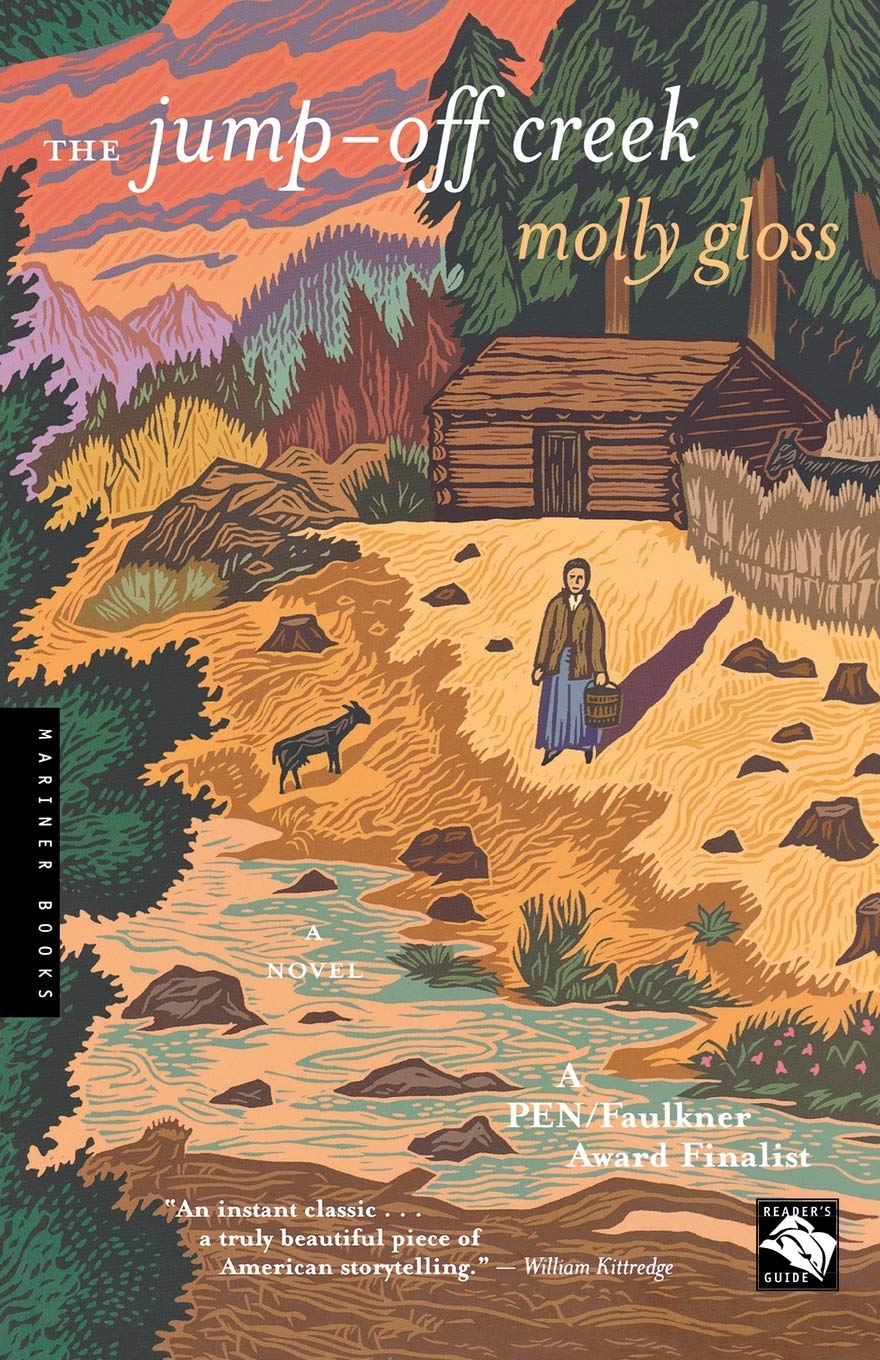
The Jump-Off Creek- Molly Gloss


Jump-Off Creek Pa 05: Molly Gloss: 9780618565870: Amazon.com: Books
Author: Molly Gloss | TitleThe Jump-Off Creek | Genre: Western | Publication Date: August 3, 2005 Number of Pages: 208 
Geographical Setting: Oregon | Time Period: 1890s

Plot Summary
Lydia Sanderson, a woman of few words and even fewer means, invested in her independence by buying a farm near the Jump-Off Creek. After making a cross-country journey, she finds her new land gone to seed. Not only must she make something of the land by winter, but poachers have been stealing local farm animals to bait and poison wolves. She is determined to survive on her own, and quickly makes friends with her neighbors Tim Whiteaker and Blue Odell. Together, the three settlers set out for battle against nature, poverty, and wolfers’ greed.

Characteristics for Western:
Setting- This story is set against a “dangerous but beautiful backdrop” filled with “treacherous terrain” (Saricks 152). The opening chapters, which describe the end of Lydia’s passage to the Jump-Off Creek, describe especially treacherous terrain. There is also an “imprecision of time and place,” as the best way to determine where or when this book is set is to read the dust jacket. However, it is set in the Western United States (Oregon) between the Civil War and 1900 (1890s) (151). Since everyone is so separated from civilization, it is easy to lose all sense of time and place.

Characterization- Lydia combines the primary “loner” protagonist with the secondary “good woman” who “works to make a home in the wilderness” (152-3). She (as well as Tim and Blue) is stoic and taciturn, tackling hard work and impossible living conditions without batting an eye.

Storyline/ Theme- Saricks listed redemption and justice as common Western storylines. Lydia could count as “damaged characters seeking escape, healing, or redemption,” as she wants to begin her own life (no spoilers as to why) (153). This theme could also be attributed to other characters, although the side characters are written sparsely so it may require a stretch. Furthermore, Saricks lists “the difficulties of living in a harsh landscape” as a major Western theme, which is at least 80% of the book’s content (151). Justice also plays a mild role in the book, as the wolfers are presented as a form of villain. However, this justice comes at a price and is not played as strongly as in traditional Westerns.

Language/Style- Most of the book is devoted to describing work, and everything is told in a “straightforward fashion” (155). While the dialogue is not quite “monosyllabic” as Saricks cites, it is very sparse (155). Both the characters and the overall prose is very mater-of-fact, and Gloss does not shy away from gore, violence, or any other forms of unpleasantness.

Read-alikes:
Nonfiction-
The Magnificent Mountain Women- Janet Robertson
Pioneer Women: The Lives of Women on the Frontier- Linda S. Peavy
Bad Land: An American Romance- Jonathan Raban

Fiction-
Caroline- Sarah Elizabeth Miller
One for the Blackbird, One for the Crow- Olivia Hawker
The Trouble with Patience- Maggie Brendan
These is My Words- Maggie Snelling
Similar Authors: Kent Haruf, Sandra Dallas, Kaye Gibbons


Thursday, March 12, 2020

Book Club Experience


I came to work early to attend my coworker’s book club. They were discussing The Light in the Ruins by Chris Bohjalian, and my answers might have some spoilers for the book itself (fair warning). Aside from the leader (my coworker), Linda (who was also observing), and myself, four other people attended the group. ILoveLibraries estimated about 8-16 people for book clubs, but this size group worked much better than that size would, since it gave everyone ample time to bond and share their thoughts.

Who is asking the questions, is there a leader or do people take turns?
My coworker was the conversation leader and asked most of the questions in order to get a discussion going. Some of the other attendees asked questions as they came up, but they were mostly for clarification.

If there is a leader, does the leader answer the questions as well or let the attendees respond first?
The discussion was very open, so my coworker would mostly pose questions to the group and share her impressions once the other attendees had shared theirs. It was very conversational, and she mostly let attendees get their share in. Her style reminded me of Hoffert’s discussion of the leader as a facilitator, as she guided the conversation when needed but could also step back and be a neutral presence too (which allowed the attendees to speak up).

What type of questions are asked? Any involving just yes or no answers?
Most of my coworker’s questions centered around the attendees’ perceptions of the book (i.e. “What did you think of this book?”, “Did anyone try to figure out who did it? Was anyone right?”, “This character said they had to do this, but do you think they really had to?”, etc.). A few questions (like the last two examples) were yes or no questions, but they invited elaboration. None of the questions were closed to just a yes or no answer. She also shared a few of her own perceptions of the book, which were phrased as non-question questions (i.e. “I had thought this character was going to have a bigger role in the book…” which allowed attendees to weigh in on the character).
Most of the attendees’ questions were to clarify or ask the others’ opinions (i.e. “Was the murderer demented? Why did they do it?”, “This event was during the wartime, right?”, “Why did the murderer remove their hearts?”, “Was this character the one whose father was a surgeon or was that someone else?”, etc.).

Do all attendees actively participate? Do any attendees swoop in and steal all the spotlight?
All of the attendees had a good rapport already, so they were all very enthusiastic in sharing their thoughts about the book. They also jumped to connect the book to their own experiences and really seemed to bond over that personal discussion. No one “swept in” or “stole all the spotlight”- it was a very egalitarian conversation.

What is the atmosphere of the discussion, where is it taking place at?
The discussion was held in my library’s meeting room, and everyone sat in chairs around pushed-together tables. It was a very friendly and informal atmosphere, with a smaller group than usual (four people). Everyone seemed to already know each other (although name tags were still provided), so it felt like a lot like a social meeting even though the discussion was about the book.

Are snacks or drinks provided?
The book group was called the “Coffee Talk” book discussion, so there were snacks and coffee available. My coworker said she tries to go to local businesses for snacks- today was different kinds of candies (truffles, marshmallows, etc.).

What types of books does this book club normally discuss?
This group apparently discusses a variety of books, but mostly historical fiction. They discussed trying more nonfiction at the end of the meeting, offering histories or biographies as options. The books they listed for previous meetings appear to be close to literary or relationship fiction as well (but primarily historical). It reminded me of the Vienna Court Book Club in Goldstein’s article, since everyone’s encouraged to recommend books that align with their personal preferences (33).

Saturday, March 7, 2020

Special Topics Paper- Perceived Bias

There are myriad articles discussing how to recognize one's own bias and how to try and diminish it as much as possible in daily work. However, my library (and I'm sure many other libraries in the United States) has had issues with patrons claiming that having certain materials (almost always on a diversity basis) was "pushing an agenda." This perceived bias ends up creating a lot of confusion, as neutrality can be interpreted either as "showing everything" or "avoiding controversy." I chose to explore how to define neutrality, bias, and how to navigate these perceived biases in readers' advisory.

When I looked into it, the ALA said that "showing everything" is the only way to be neutral, and librarians should actively encourage political discourse and not fear controversy. An editorial in PublicLibrariesOnline argued that libraries should be politically neutral, but defined political neutrality as showing information on all candidates and political parties. It did not go into specific politicized issues, though, which is where the issue of perceived bias lies. Another editorial in SchoolLibraryJournal argued that libraries are inherently biased, as they have clear positions on issues like diversity and inclusion that are often highly politicized. Furthermore (they argued), libraries should embrace this bias instead of creating a false neutrality and clashing with their core beliefs.

My conclusion was that this perceived bias wasn't actual bias, in fact it was the opposite. Making recommendations with a diverse set of creators, subjects, and themes reinforces the ALA's definition of neutrality. As long as the chosen titles are based on the reader's initial requests (appropriate genre, appeal terms, etc.), there is no reason to fear recommending them. When the conversation goes from representing "x" and "y" group to "I think you should represent x and y" and "I don't think you should represent y," neutrality is completely lost. You cannot disguise censorship as political neutrality.